
SAP in Managed Services as a Driver
of Continuous Transformation

Managed services is still sometimes seen as a traditional support function. How has that perception changed in the SAP world?


Managed services in the SAP world have historically been perceived as a traditional support function, primarily reactive, cost-driven, and focused on maintaining stability. Success was measured by operational metrics such as ticket resolution time, system uptime, and adherence to SLAs, with limited visibility of their business value. 

However, this perception has significantly evolved. The shift from ownership-based models to subscription and “as-a-service” models has fundamentally redefined expectations. In the SAP context, this is reflected in the move toward cloud-based ERP, where services are continuously delivered, making managed services an integral part of the offering rather than an optional layer. 

As a result, reactive support models are being replaced by proactive, intelligence-driven operations. Modern SAP managed services focus on continuous monitoring, predictive maintenance, and system optimization using automation and AI, anticipating issues and ensuring continuous business value. 

This transformation has also reshaped how success is measured – from operational metrics to business outcomes such as process efficiency, system performance, and the ability to adopt innovation.


How has the rise of automation, AI, and observability changed the day-to-day reality of SAP managed services?


The rise in automation has significantly reduced routine effort. Tasks that once consumed substantial time, such as job monitoring, resolving recurring issues, and performing system checks are increasingly automated. This shift allows SAP professionals to move from executing repetitive tasks to designing, optimizing, and supervising automated processes. 

AI adds another dimension by introducing a predictive and proactive layer. Instead of reacting to incidents, teams can anticipate issues and make preventive decisions. This reduces firefighting and enables professionals to focus on higher-value problem solving and continuous improvement. 

At the same time, observability through solutions such as SAP Cloud ALM, brings end-to-end transparency across complex landscapes. With this level of visibility, teams can quickly identify root causes, understand cross-system impacts, and make more informed decisions.



How do managed services teams contribute to continuous improvement rather than simply maintaining the status quo?

„Being proactive, agile, collaborative, and thinking outside the box are key soft skills that enable managed service teams to go beyond maintaining the status quo and identify inefficiencies or improvement areas.”
Radmila Nikolovska - Senior Manager, PwC Poland
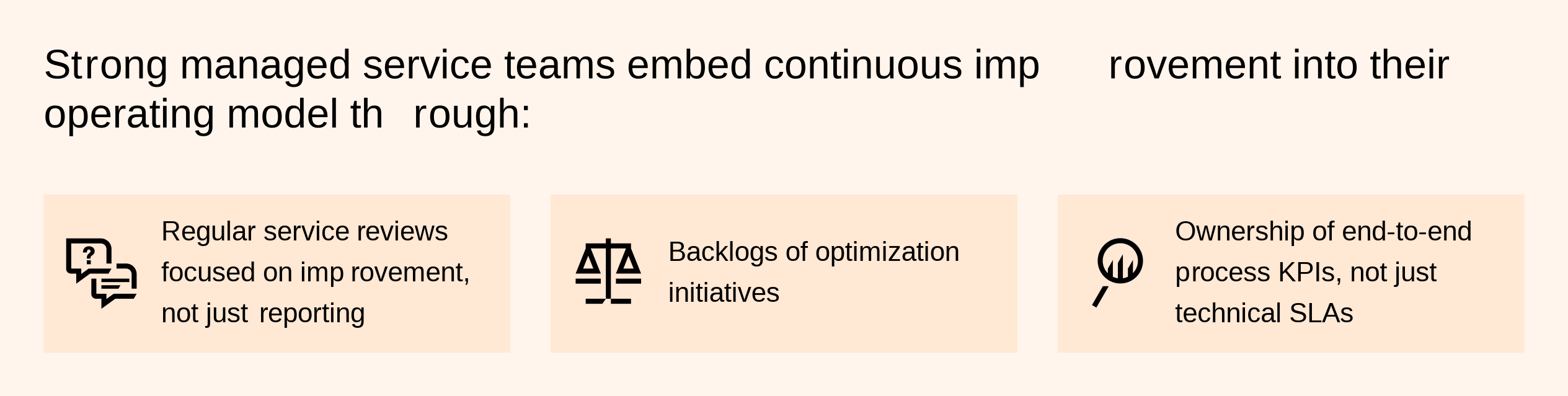
Continuous improvement comes from shifting the mindset from “operate” to “optimize”. Teams analyze recurring incidents, process delays, and user pain points to eliminate root causes, moving from reactive issue resolution to systematic process improvement. 


Data and operational insights play a key role. Incident trends, system performance data, and business process metrics help identify inefficiencies, predict risks, and uncover optimization opportunities, enabling predictive and data-driven improvements. Close collaboration with business stakeholders is essential to understand evolving priorities and identify areas where SAP can deliver more value – through automation, process redesign, or new functionality – shifting the role from technical support to business partner. Automation and standardization further support this approach by freeing up capacity for higher-value activities such as innovation and optimization.

In what way does managed services require a broader perspective across applications, platforms, processes, and business priorities?


Managed services require SAP professionals to move from component-level expertise to system-wide thinking. It requires broader perspective because their value no longer lies in managing isolated SAP systems, but in orchestrating interconnected landscapes, end-to-end processes, and business outcomes. 

In modern SAP environments, applications are tightly integrated across platforms like S/4HANA, BTP, and third-party systems. As a result, issues and opportunities rarely sit within a single module, they span across multiple applications, integrations, and business processes. Managed service teams must therefore think beyond technical components and understand how changes in one area impact the entire ecosystem. 

At the same time, the focus has shifted from system stability to process performance and business value. This requires professionals to connect technical operations with business priorities, such as order-to-cash efficiency, financial close timelines, or supply chain resilience, rather than just managing tickets or SLAs. 

Additionally, with continuous updates, cloud services, and emerging technologies like AI, teams must balance operational reliability with ongoing innovation. This demands a platform-level view understanding not only how systems work today, but how they should evolve in the future. 

Managed services are no longer about supporting systems. They are about continuously shaping how those systems create business value. What was once a reactive support function has become a strategic capability that enables organizations to adapt, innovate, and evolve in an increasingly complex digital landscape.
We unite expertise and tech
so you can
outthink, outpace and outperform